Eaton Canyon Golf Course, Pasadena
I Taught My Oldest Brother Everything I Know (It Took Nine Holes and He Passed Me on the Fourth)
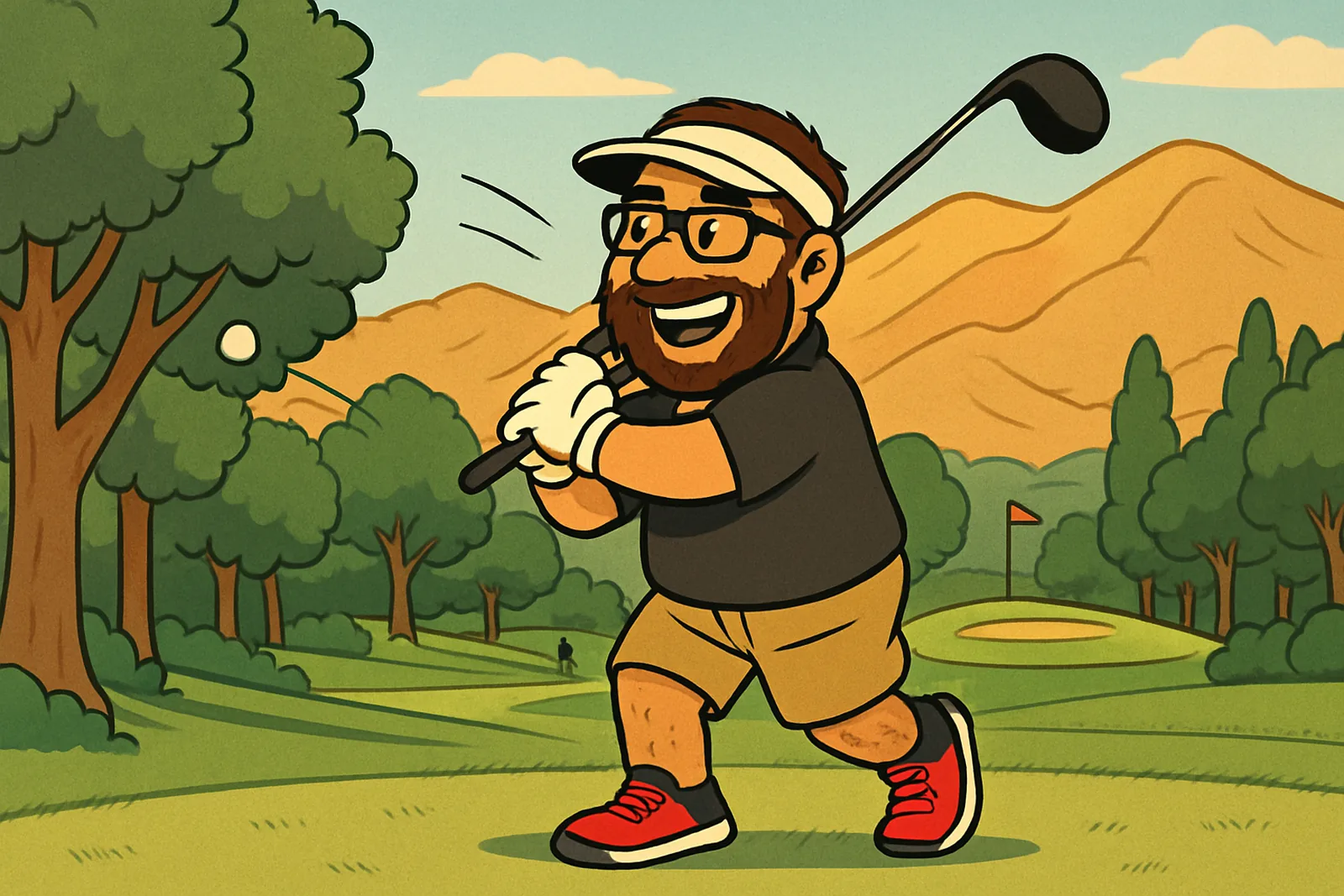
This was the week I became a mentor.
My brother Pat is new to golf. He is a lefty, he is enthusiastic, and he recently bought his very first driver, brand new, in a box, with the plastic still on the face. I have been playing for years. I have watched hundreds of hours of instructional videos, most of them after 11 PM. I figured it was time to give something back.
So I took Pat to Eaton Canyon, with our brother Chris along for moral support. It’s a county-run nine in Pasadena, par 35, tucked right up against the base of the San Gabriel Mountains. A gentle nine. A teaching nine. A place where a wise younger brother could pass his knowledge up the family tree.
I started the lesson on the driving range, which has real grass tees, a detail I noted out loud so Pat would know he was in the presence of someone who notices details.
“Keep your head down,” I told him. He kept his head down and hit it straight.
“Smooth tempo,” I told him. He swung smooth and hit it straight again.
Then I demonstrated. I kept my head down, swung with smooth tempo, and hit a ball that went sideways into the next stall and stopped politely at a stranger’s feet. The stranger handed it back to me without a word, the way you’d return a glove to a child.
“So, like that,” Pat said, “but the other way.”
“Exactly,” I said. “You’re getting it.”
The first tee
With the San Gabriels standing over the course like a very big audience, everything you do feels small. In my case that’s accurate.
Pat peeled the plastic off his new driver. I unzipped the headcover on The Regret, my 2011 driver, which I bought used and which has the faded paint and oversized head of a club that remembers a different era of hope.
They looked at each other, the two drivers. One shiny and full of promise. One that had seen things.
Pat went first. He made a lovely, unhurried lefty swing, and the ball flew high and long and landed in the middle of the fairway like it had a reservation.
The Regret and I went next. We hit it about two-thirds as far, mostly sideways, and into a spot that technically counted as “near the fairway” if you were feeling generous and standing in the right place.
“Nice,” said Pat, sincerely. That’s the thing about Pat. He means it.
The overcorrection
The fairways here are narrow, with trees close by, and they roll up and down through the foothills, so every hole feels like a hallway somebody built on a slope.
I slice. Everyone knows I slice. Early in the round I explained to Pat, with real gravity, the veteran’s technique of aiming left to play the slice.
“You aim way over there,” I said, pointing at the trees on the left. “And then the ball curves back to the middle. That’s experience.”
I aimed way over there. I made the cleanest swing of my life. The ball flew perfectly, beautifully straight. It did not curve at all. It went exactly where I aimed it, deep into the trees on the left, and disappeared with a small, final rustle.
Chris watched it go, then turned to me with complete admiration.
“That was technically perfect,” he said. “You hit it exactly where you were pointing.”
“That,” I said, “was a demonstration of what not to do.”
Pat nodded and made a small note on his scorecard. I didn’t ask what.
The rolling part
On the next hole my ball came to rest on a slope, with the ball well above my feet. I explained sidehill lies to Pat at length: choke down, aim right, trust the hill.
Then his ball ended up on the same slope, and he very kindly ignored everything I’d said, swung normally, and put it on the green. I choked down, aimed right, trusted the hill, and the hill let me down.
By the fourth hole Pat was ahead of me. By the sixth he was asking Chris for tips, which I tried not to take personally. By the eighth I was asking Chris for tips, which I also tried not to take personally.
The course opened in 1962, and it was originally planned as an 18-hole layout. Somewhere along the way it became a nine. I respect that. It’s a place that knew when to stop. I am not a man who knows when to stop, which is why I had two mulligans on the seventh and still put down a six.
The comeback
But here is what nobody tells you about narrow fairways: they come with a lot of trees, and the trees are full of other people’s golf balls.
I spent so much of the afternoon under those trees looking for my own that I kept finding everyone else’s. A clean one with a little smiley face drawn on it. A yellow one. A very old one with a faded logo from a company I’m not sure still exists.
I lost three balls. I found five.
So after nine holes, Pat had the better score, Chris had the best score, and I walked off the ninth green with two more golf balls than I’d arrived with. In some sports that’s called a profit.
I shook Pat’s hand and told him he had a real future. He thanked me for the lesson. He meant it.
Next week I’m going to teach Chris.
Fifty-four strokes on a par 35. But I’m up two balls, and I’ve decided that’s the number I’m reporting.