Torrey Pines Golf Course (South), San Diego
Local Man Ties U.S. Open Field on Zero Holes, Remains Optimistic
I had one goal at Torrey Pines, and it was a reasonable one.
The South Course has hosted the U.S. Open twice, in 2008 and 2021. I am not going to win a U.S. Open. I have made peace with that. But the third hole is a par 3, and a par 3 is the great equalizer. On a par 3, the best golfers in the world and a man with a secondhand bag are briefly doing the same thing: hitting one ball at one green.
All I had to do was make a three. Tie the field. One hole.
My brother Pete came along. Pete keeps score in pen. He claims it is because pencils smudge, but I think it is because pen is forever, and Pete believes in forever.
The South is a par 72 on the cliffs above the Pacific, a city course in La Jolla, and standing on the first tee felt like walking onto a stage where everybody else knows their lines.
I took out The Regret, my 2011 driver, and had a word with it.
“Big day,” I said. “The ocean is watching. History is watching. Pete is watching, and he brought a pen.”
The Regret said nothing, which is how it agrees to things.
“Just a nice, gentle fade,” I said. “Nothing dramatic. Be the club I believed in when I bought you used.”
I swung. The Regret answered with a slice so committed it felt personal, a long, curving statement of independence that ended in the rough along the tree line. Pete watched it the whole way, with the patient interest of someone following a parade that has turned down the wrong street.
“Good contact,” he said, and meant it. That’s the hard part about Pete. He always means it.
The second hole went about how the first one did, only quieter. Then came the third.
It plays sharply downhill from an elevated tee, and beyond the green there is nothing but the Pacific Ocean, blue all the way to the end of the world. It is the most beautiful place I have ever stood while holding a golf club, and I have stood in a lot of places holding a golf club, most of them in the rough.
The wind was moving around. Not blowing, exactly. Thinking. It came off the water, paused, changed its mind, and came back from a different direction, like a cat that wants to be let in, then out, then in.
I pulled a five-iron. I put it back. I pulled a six. I held both up to the sky like I was weighing fish.
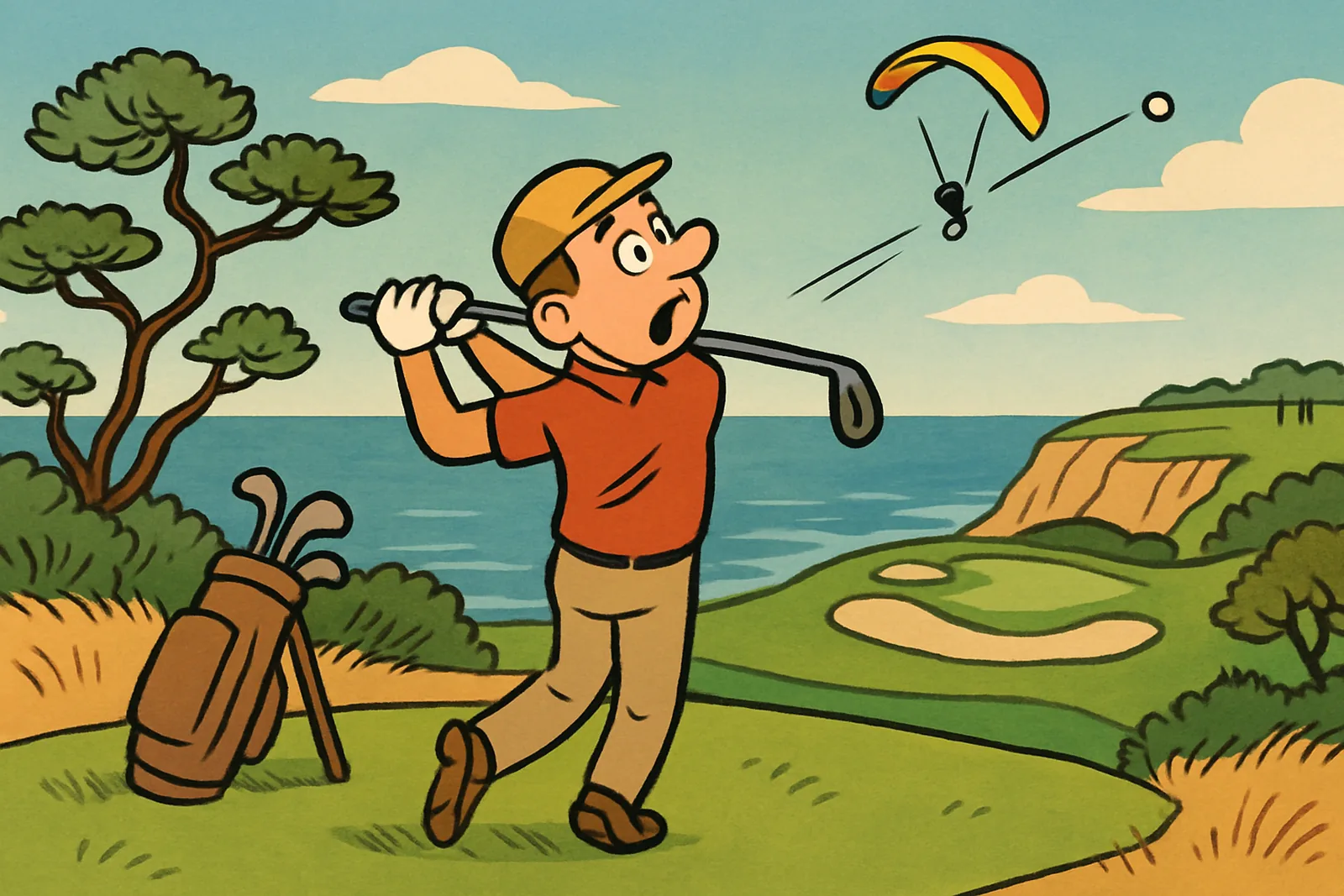
Then, out over the bluffs, a paraglider drifted into view. Somebody from the gliderport nearby, hanging in a bright little wing, riding the same breeze that was about to ruin me.
I took the six. I swung. I made the best contact of my life.
The ball went straight up into the wind and stopped. It just hung there, like it had spotted the paraglider and wanted to chat. For a long, peaceful moment, my golf ball and a total stranger were both floating over the Pacific, enjoying the view, neither of them in any hurry to come down.
Then my ball remembered gravity and dropped, very gently, into the one spot on that hillside I had been trying hardest not to think about.
It took me two more to reach the green. I two-putted. Five.
“So that’s a five, then,” Pete said, and the pen moved. Forever.
Somewhere later on the front nine, my ball came to rest under a Torrey pine, the tree the course is named for. It is a critically endangered species, and the ones exposed to the coastal wind get twisted into sculptural shapes, like bonsai trees that grew up and kept their opinions.
I stood there looking up at it. It was leaning hard to one side, limbs out at strange angles, holding a pose no instructor would ever approve. It looked exactly like my follow-through. The difference is that the tree is rare and treasured and protected, and I am a man who just made a five on a par 3.
I punched out sideways. Pete’s pen made a small, neat mark.
On the back nine, Pete read my card back to me, hole by hole, in the gentlest voice imaginable.
“Ten was a seven,” he said.
“The second ball on ten was a practice ball,” I said.
He nodded, kindly. “So that’s a seven, then.”
The course was built on the site of an old Army camp, and by the fifteenth I understood the feeling. I was an army of one, in orderly retreat, giving up ground one honest number at a time.
Afterward we sat looking out at the ocean while Pete totaled the card. He added it twice, to be fair to me. It came to 117 both times.
I didn’t tie the field. Not on the third, not anywhere. But for about four seconds over that cliff, my ball was flying higher than anyone’s, and I’m holding on to that until the third and I meet again.